Custom Perfume for Spas and Hotels: Evaluating the Supplier
Spa and hotel lines buy fragrance differently from retail brands: the product is part of a service, it is stocked at volume, and it often has to work in a room as well as on skin. The supplier evaluation therefore tests four things — whether the brief is understood, whether the scent performs in context, whether the technical file is complete, and whether the partner can scale the format. This article lays out the evaluation process, written for a sourcing manager commissioning a custom scent for hospitality use.
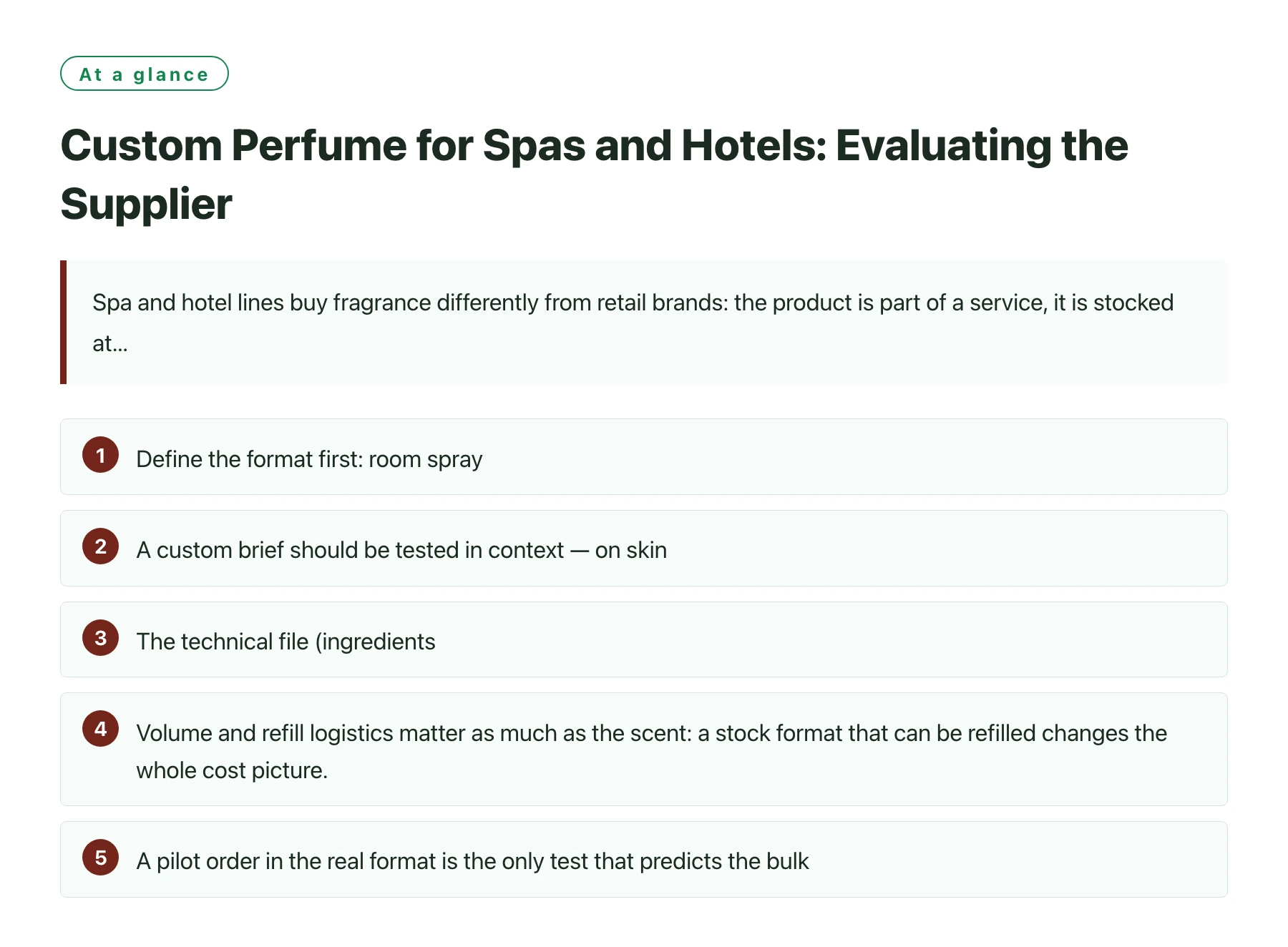
Key takeawaysDefine the format first: room spray, diffuser, body wash and candle are different products with different stability and use-limit profiles. · A custom brief should be tested in context — on skin, in a room, after hours of diffusion — not only on a blotter. · The technical file (ingredients, allergens, standards compliance, safety data) decides whether the amenity can ship to the properties' countries. · Volume and refill logistics matter as much as the scent: a stock format that can be refilled changes the whole cost picture. · A pilot order in the real format is the only test that predicts the bulk, and it should be planned into the evaluation budget.
A hotel group ordering a custom scent is not buying a perfume; it is buying an atmosphere that has to survive housekeeping rotation, room sprayers, soap pumps and lobby diffusers. That changes how you evaluate the supplier, because the sample that smells lovely on a card is not the sample that matters.
The process below is the one used by sourcing teams that buy fragrance for several properties at once. It is deliberately short — the goal is a decision in a few weeks, not a procurement saga.
The evaluation, step by step
- Write the format list before the briefDecide which products the scent must cover: room spray, diffuser liquid, body wash, lotion, candle. Each is a different product with different stability requirements, so the brief is only coherent once the list is fixed.
- Send the brief and watch the questionsCommission from scratch rather than choosing from a stock list, which means working with a manufacturer that builds custom scents instead of a catalogue. The useful signal is how the supplier responds: does it ask about the properties' countries, the refill logistics and the guest profile, or does it answer with a price?
- Test the scent in contextAsk for trials in the real formats — a room spray tested in a closed room, a body wash tested in a shower, a diffuser run for days. The blotter tells you the perfume; the context test tells you the product.
- Review the technical fileIngredients, allergen declaration, standards compliance, safety assessment and batch documents. This is the step that decides whether the amenity can legally enter the countries where the properties operate.
- Run a pilot order in the real formatA small production run of the actual products, through the same filling line that will serve the bulk. No photography, no desktop sample: the pilot is the first time the product exists as it will be delivered.
What makes spa and hotel lines different
The scent is part of the stay. Guests associate a hotel with a smell the way they associate it with a lamp or a bathrobe, and that association is built from several products at once — the spray in the room, the soap in the bathroom, the candle at the front desk. Consistency across formats therefore matters more than projection, and it is a production attribute as much as an olfactory one.
Categories carry their own use limits
Body products and home fragrance products are different categories for safety purposes, and the use limits for individual fragrance materials are set per category in the IFRA standards [1]. The same accord that works in a candle may need adjustment at the levels allowed in a body wash, so the supplier's formulator has to manage the scent across categories rather than pour one concentrate into everything.
Stability and microbial testing are part of the plan
A room spray and a body wash are tested differently, and both belong in the schedule before the first bulk order. Safety and microbial evaluation of cosmetics and household products is standard practice among testing laboratories [2], and a hospitality buyer should see the testing plan in the quotation rather than discovering it later. Products that sit in rooms and showers are used by many guests, which is not the use pattern of a retail bottle.
Refill and volume change the economics
Hotels buy amenity products in volume and refill them constantly, so the format decision drives cost more than the scent does. A refillable pump format, a bulk diffuser concentrate and a standard soap cartridge are decisions to make with the supplier early. A plant organised as fragrance manufacturing under one roof can keep the refillable bulk and the filled units under the same quality control, which matters when one scent runs through several formats and the refills have to match the original batch.
Scorecard for comparing candidates
| Criterion | What good looks like | Red flag |
|---|---|---|
| Brief comprehension | Asks about countries, formats, refill logistics, guest profile | Answers with a price before asking any question |
| Development response | Two to four directions within a stated time | One sample, or samples that ignore the format list |
| Context performance | Scent verified in room and shower trials | Only blotter or card evaluations offered |
| Technical documentation | Full file delivered with the first samples | File appears only when artwork is requested |
| Use-limit handling | One scent managed correctly across categories | Same concentrate proposed for every format |
| Lead time and scaling | A stated pilot date and a plan for the bulk run | One date, no assumptions, no pilot |
Score every candidate on the same six rows, in writing, before the samples arrive. The prices are comparable; the scorecards are usually not.
The practical notes from buying for properties
Two details consistently separate good hospitality fragrance projects from bad ones. The first is the retained reference: the pilot batch must produce a sealed, dated, batch-numbered sample held by both sides, because three properties will reorder from three different managers and each must be able to compare against the same reference. The second is the country list: the properties' countries decide the required documents and any restrictions, so the list has to be handed to the supplier in week one, not discovered when the first shipment is stopped.
For properties in Asia, a manufacturer based in the same region shortens the logistics chain and the reorder loop. A Guangzhou fragrance house such as Guangzhou Xuelei is an example of the geographic setup worth comparing — the point is not the name, it is that distance, lead time and reorder cost are evaluation criteria like any other.
The pilot order is the cheapest insurance in hospitality sourcing. A full pilot through the real filling line, with the real pack and the real documentation, answers every question that a desk evaluation cannot — and it costs a fraction of discovering the answers in front of guests.
Sources
- IFRA Standards Library (International Fragrance Association) —— The IFRA Standards Library lists the restrictions the fragrance industry applies to individual fragrance ingredients, based on safety assessments; it is the reference point for compliant fragrance formulation.
- SGS: Cosmetics, Personal Care & Household Testing —— Testing, inspection and certification services for cosmetics and personal care, including microbiological, stability and safety testing aligned with cosmetics GMP.
Frequently asked questions
Should a hotel scent be different from a retail perfume?
Usually yes. In a hotel the scent has to perform consistently across formats and stay neutral in a room over long periods; projection, longevity and bottle aesthetics matter less. The evaluation should test the product in its use context, not treat it as a retail fragrance with different packaging.
How many scent directions should I ask for?
Two to four is a reasonable ask for a custom brief. More than that usually means the brief is unclear, and it slows the whole project. The quality of the directions matters more than the number, and the context tests decide the winner.
Who owns the scent after the project?
That is a negotiated term. For hospitality, exclusive use by the property group is common, and it should be written into the agreement with the ownership of the formula, the mould and any design files settled in the same conversation as the price.
Can one scent cover the room spray, the soap and the candle?
Yes, if it is formulated per format. Body and home products sit in different categories with different use limits, so the supplier manages the scent across formats rather than diluting one concentrate. Ask how the formulator handles that adjustment before you commit.
What should I bring to the first supplier meeting?
The format list, the countries of your properties, a volume estimate, reference scents and the names of the people who will approve samples. The conversation is twice as productive when the supplier has already seen the constraints.